
If a knee becomes suddenly very painful, hot or significantly swollen—particularly with fever, feeling unwell or difficulty bearing weight—seek urgent medical assessment. Joint infection is uncommon but requires prompt treatment. Do not wait for a routine physiotherapy or ultrasound appointment to exclude it.
What does ‘knee effusion’ mean?
An effusion is an increase in fluid inside the knee joint. A small amount of fluid is normal, but more fluid may develop in response to joint irritation. Swelling is a finding, not a diagnosis: fluid may be associated with osteoarthritis, a meniscal or ligament injury, an inflammatory condition, infection or another cause. The history and examination matter more than the word ‘effusion’ alone.
Common patterns a clinician may consider
After a twist or fall
An injury mechanism, immediate swelling, locking or giving way can raise different questions from slowly developing stiffness. Fracture and significant internal injury need appropriate medical assessment.
Gradual pain and stiffness
Osteoarthritis can cause pain, stiffness and intermittent swelling. NICE recommends tailoring management to symptoms and function, with therapeutic exercise as a core treatment.
Persistent or multiple swollen joints
Prolonged swelling and morning stiffness involving several joints or small joints may need medical investigation for inflammatory arthritis. NICE recommends specialist referral for suspected persistent synovitis.
Can ultrasound see the fluid?
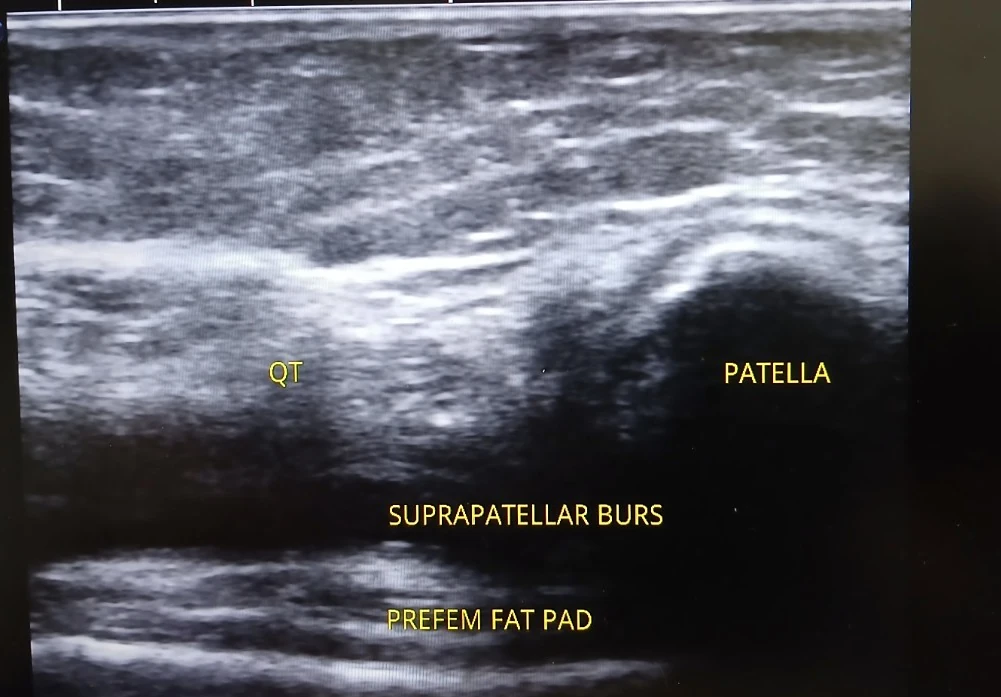
Diagnostic ultrasound may demonstrate fluid in the accessible suprapatellar recess and other parts of the knee. It can also help examine selected tendons and bursae. However, seeing joint fluid does not establish its cause or rule out infection. Ultrasound does not replace a clinical examination, and other imaging or laboratory investigation may be required.
Do you always need imaging for osteoarthritis?
No. NICE NG226 generally recommends a clinical diagnosis of typical osteoarthritis in adults aged 45 and over with activity-related joint pain and no morning stiffness, or stiffness lasting no more than 30 minutes. Routine imaging is not recommended simply to confirm or monitor usual osteoarthritis, unless features are atypical or another diagnosis needs consideration.
What may physiotherapy involve?
Following an appropriate assessment, care may involve advice on activity, progressive strength and movement work, help with walking or stairs, and gradual return to function. Exercise type and dosage should be chosen for the individual, rather than copied from someone else's report. If swelling is worsening, the knee is hot or the cause is uncertain, medical assessment takes priority over exercise progression.
Explore further
Primary sources and further reading
- NHS (n.d.) Septic arthritis. Patient information and urgent advice. View primary source
- NICE (2022) Osteoarthritis in over 16s: diagnosis and management, NG226. View primary source
- NICE (2018, updated 2020) Rheumatoid arthritis in adults: management, NG100. View primary source
Guidance is condition-specific; recommendations should not be applied automatically to unrelated injuries. For an individual plan, request a clinical assessment.
Need a fresh physiotherapy assessment?
We can discuss symptoms, treatment options and the most useful next step. The website accepts enquiries only; it does not provide instant online bookings.
Coventry & Rugby initial physiotherapy assessments £70; Wolverhampton £60. Follow-up physiotherapy treatment £40.